
Notes and Highlights on John Smith
lending further context to his boast

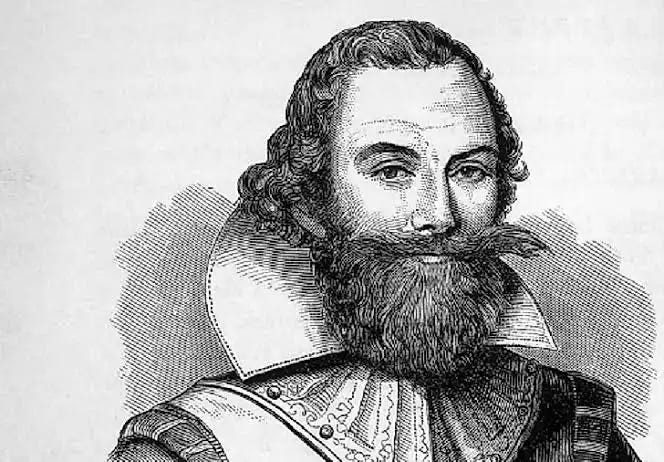
His boast
Notes are my own. Quotations come from the book American Genesis, written by Alden T. Vaughn.
Writing about himself in the third person, Captain Smith recalled his studies in early adulthood:
“His studie was Machiavills Art or warre, and Marcus Aurelius; his exercise a good horse, with his lance and Ring…”
Quite often Smith’s active life, one certainly influenced by Machiavelli’s writing, led him to perilous situations. By all accounts, Smith met these situations with fearless resolve, a resignation of contentment with the life he’d led up until that point. His attitude of “come what may” in the face of death was an effective use of Aurelius’s writing, with Christianity remaining as his foundation.
Speaking of his Christian faith…
“God (being angrie with us) plagued us with such famin and sickness that the living were scarce able to bury the dead…”
We’re so propagandized to resent the men who built America, to believe in the preposterous idea that the settlers had no conscience. We better do well or else God will starve us is not the sentiment of a man without a conscience. Do sentiments like this even exist today?
The fear of one man carries more weight than the concern of many. Smith used this principle to his advantage when dealing with the natives:
Through it all, Powhatan felt powerless to resist. ‘Captain Smith, he protested, ‘you insist on having whatsoever you demand.’ … Rightly or wrongly, Smith had not made the Indians ‘subject to the English,’ as he claimed, but to himself.”
I would dispute the author’s claim at the end of the quote. I contend that by virtue of making the natives subject to himself, Smith had made them subject to the English. Is this Elite Theory?
Liberty is indeed a founding principle of this nation. Neglected, however, is the oft-neglected principle of Authority…
“Some muttered at Smith’s strictness, but of the two hundred men only about eighteen died during his administration, eleven of them by drowning when they went foraging in violation of the president’s orders.”
…for there is no Liberty to be had when no one survives. And survival often hinges upon one man’s endeavor to compel the toil of many.
More:
“Smith’s principle solution to both indolence and dissent was military discipline. He divided the entire colony into units of ten or fifteen as their tasks required, established a rotating watch, and indoctrinated the able bodied in military drill. Each Saturday the president mustered his men in a clearing — appropriately called Smithfield — near the fort where he taught them how to march and maneuver, and how to handle a musket. While his marksmen blasted away at trees, ‘sometimes more than an hundred of Salvages would stand in amusement.’ That too was Smith’s modus operandi: he wanted the Indians to see the destructive power of the English firearms. He also wanted them to know that the settlers were healthy and under vigorous leadership.”
Despite keeping the settlement alive, the misguided utilization of empathy, even back then, sought to disrupt and destroy:
“Captain Samuel Argall arrived at Jamestown ‘with letters that much taxed our President for his hard dealing with the Salvages’ and for failing to load the ships with marketable commodities.”
Though the War of the Revolution was still nearly two hundred years away, its early seeds are planted here. Does England—across that vast pond—truly know what’s best?
And thus the ramifications of not endorsing Smith’s leadership:
“There were five hundred colonists in Virginia when John Smith departed for England in October 1609; only sixty remained six months later.”
Nothing else to add here.
In attempts to get back on track the Virginia Company enacted strict immigration measures that Smith would’ve certainly endorsed:
“John Smith undoubtedly read with a mixture of approval and bitterness the repeated insistence that no ‘idle and wicked persons’ would be accepted anymore; the company now required each candidate for emigration to apply in person and present ‘some good testimony of his religion to God, and civil manners and behavior to his neighbour…’”
Much debate has been had over immigration and how it pertains to America. Restriction and particularism is more accurate and consistent with our foundational heritage than “let them all in.” Anyone claiming otherwise is ignorant of our history and not to be trusted.
Related, there’s something to be said about reduction as a means for creating order:
“Captain Smith had been able to coerce his men partly because the colony was small enough for him to keep an eye on everyone, and partly because every man could see that Smith drove himself as hard as he drove them.”
The Protestant Work Ethic is less an individualist ideal and more a collective pursuit, often inspired by one man leading the way.
Forget economic and empiric advancement for England…
“He had been in Africa, Asia, Europe, and America, and of all he considered America ‘the fittest place for an earthly Paradise.’”
…America stood above and alone in the eyes of Captain John Smith.
I have for quite some time now come to the conclusion that John Smith should be just as an important American cultural figure as the 1700s Founding Fathers