
Captain John Smith's Boast as the First American
in the likeness of...

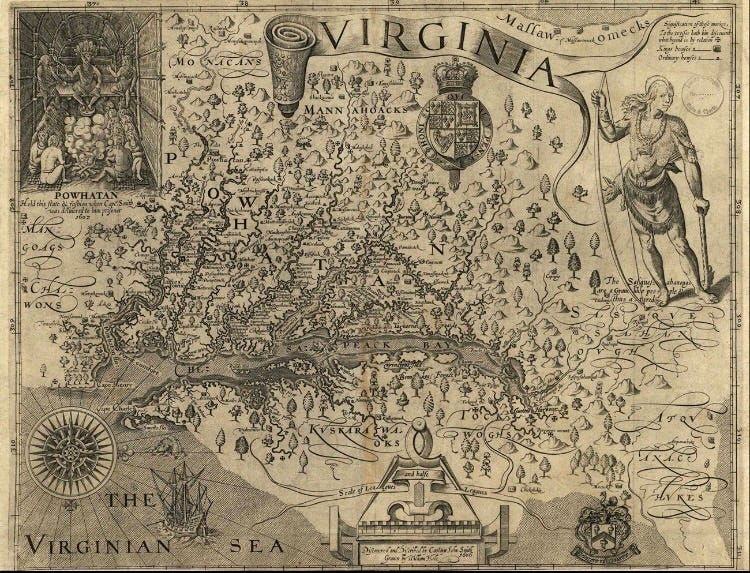
I readily admit that I am not one to hold my tongue. Blatant honesty, for me, has been both a strength and at times a weakness—or perhaps deterrent is a better term; initially, anyway. Because while I’ve started duels some would call foolhardy, I’ve yet to lose any of them. I’m still here, aren't I?
And as we make land upon these beautiful shores of Virginia, I briefly reflect on the life I’ve already lived. This is not the first time I’ve been a prisoner, though it is the first I’ve been placed in chains by my own countrymen.
They say that I tried to start a mutiny. Falsity! Can I help it that the men aboard trust me most? I’ve accomplished the most. And I am the most accomplished, not of course by birth but of deed, which is more important. Am I supposed to be quiet about these truths? Humility, at this moment in my life, is not one of my stronger qualities.
I know they're not going to follow through with my hanging. My name is on that secret list provided by the Company, counted among the First Council of Jamestown. My name will remain on this list that saves me but only nominally, because I’m given a position that keeps me away, negotiating with the savages, exploring the territory, not dealing in the day-to-day necessities of building.
Ah, well. Sooner or later, this settlement will be mine to lead. I know this in my heart.
With regard to the building of the settlement, these other men in charge are not fit to lead. Perhaps worse, the men tasked to follow are not fit to follow. Meaning, of course, neither is fit to build. These are gentlemen, good men most of them, but settlers they are not.
They’re here for gold, whether real or in some other form, here to enrich themselves through the enrichment of the Company. I understand this motivation. Indeed, it is the task that’s been set before us. But to even begin, we must lay a foundation—and these are not the type of men to willingly toil and till upon such a fertile land. They must be whipped into it.
And what land to lay a foundation! Do they not see what rich lives we could build here? Forget gold, let us sow seeds of Paradise—forget the plans of the Company, build instead a Society!
—
But first, my nominal “banishment,” my being sent away. Sure, these tasks may be important, but are they the best use of my abilities? Whether I return safely or not is not a concern of theirs; or, it is, but nefariously so. Still, the opportunity to explore excites me—how could it not?
A safe return is almost immediately met with challenge. One that ensures I’ll be the only one of my band with possibility of return. A savage attack results in my men dead and me once again playing the role of prisoner, this time at the hands of king Powhatan.
I assure you, however, my imprisonment nor my men’s deaths come without a fight. Later, I will use the defense of my men and myself against these savages as a form of defense for the settlement at-large against the savages—I am not to be trifled with.
While prisoner I once again escape death; how I escape is a bit of a blur—
—
Returning to the settlement forces a new level of respect, but not before one more threat of going to the gallows, this time for the sin of returning alone.
They’ll never know how hard I fought against the deaths of the rest of the band, but they should at least know that I made the struggle, such fight being within my character. In the end, they determine I did what I could to save them, as hanging is again averted. The savages will pay for this—I am not to be trifled with.
After all of this, the men of the settlement come to one other determination: that just maybe I have something to say that’s worth listening to. To be sure, I do.
“Get to work!”
With a little more prodding, perhaps some threatening (whipping even), they—we—eventually do get to work. There’s not much else we can do. Our other options are not too appealing: starve to death or get killed by savages. And if these are not motivation enough, I give the men one more reason to engage: by yelling at them whilst being the hardest working among them.
As each man ahead of me (by birth, not deed) fails to lead, eventually time comes to elect a new head of Council. I am the inevitable choice. “President John Smith.” I like the sound of that. But I don’t let the people know this. Instead, I accept the position begrudgingly, as something I cannot in good conscience turn down.
Soon, the Company will not enjoy the sound of “President Smith.”
Until then, I get the settlement up and running, forwarding it in ways that seemed unlikely just days ago. I would say I have it thriving but far be it for me to boast about such things. The deaths aren’t near as frequent, we’re storing food, exploring and building further inland. Are these the main goals of the Company? Not necessarily—but survival is primary at present.
Early on, Powhatan and more like him try their best to prevent such survival. They don’t so much anymore. I make them afraid of me, have my men train in open fields where I know they’re being watched. As a negotiator, I say outlandish things, threaten a form of violence these savages have never seen before. They should be afraid of me. I give them reason to be so. I’m not to be trifled with.
But the Company believes they have better ideas with regard to negotiation. Sitting atop their list of grievances against me is my ability to stave off death at the hands of the savages. They say I’m too harsh. And the lack of “gold” doesn’t hurt their cause against me.
Here again is another list with my name on it. This time, in my view, essentially a recommendation that I be removed from my position. Mentally, I am injured. Physically, too. I return to my old home, leaving my new one—the one I’ve set upon a path of sustenance.
After my departure, the attacks and subsequent deaths increase. The food reduces. The “gold” continues to be undiscovered. Still, by the grace of God and by the skin of its teeth, Jamestown—Virginia!—survives, presses on. I take solace in knowing that I got enough to listen to me who could carry on my message.
I’ll not get to see the Virginia Society I envisioned, the paradise that America promises. Nor do I have flesh and blood who might carry on my legacy in that new land. But there are men who remain and persist upon the soil. Theirs is a collective flesh and blood that I helped preserve and sustain, a staving off of death being the birth pangs of a new nation.