
William Bradford: Trials and Triumph
bio-sprint

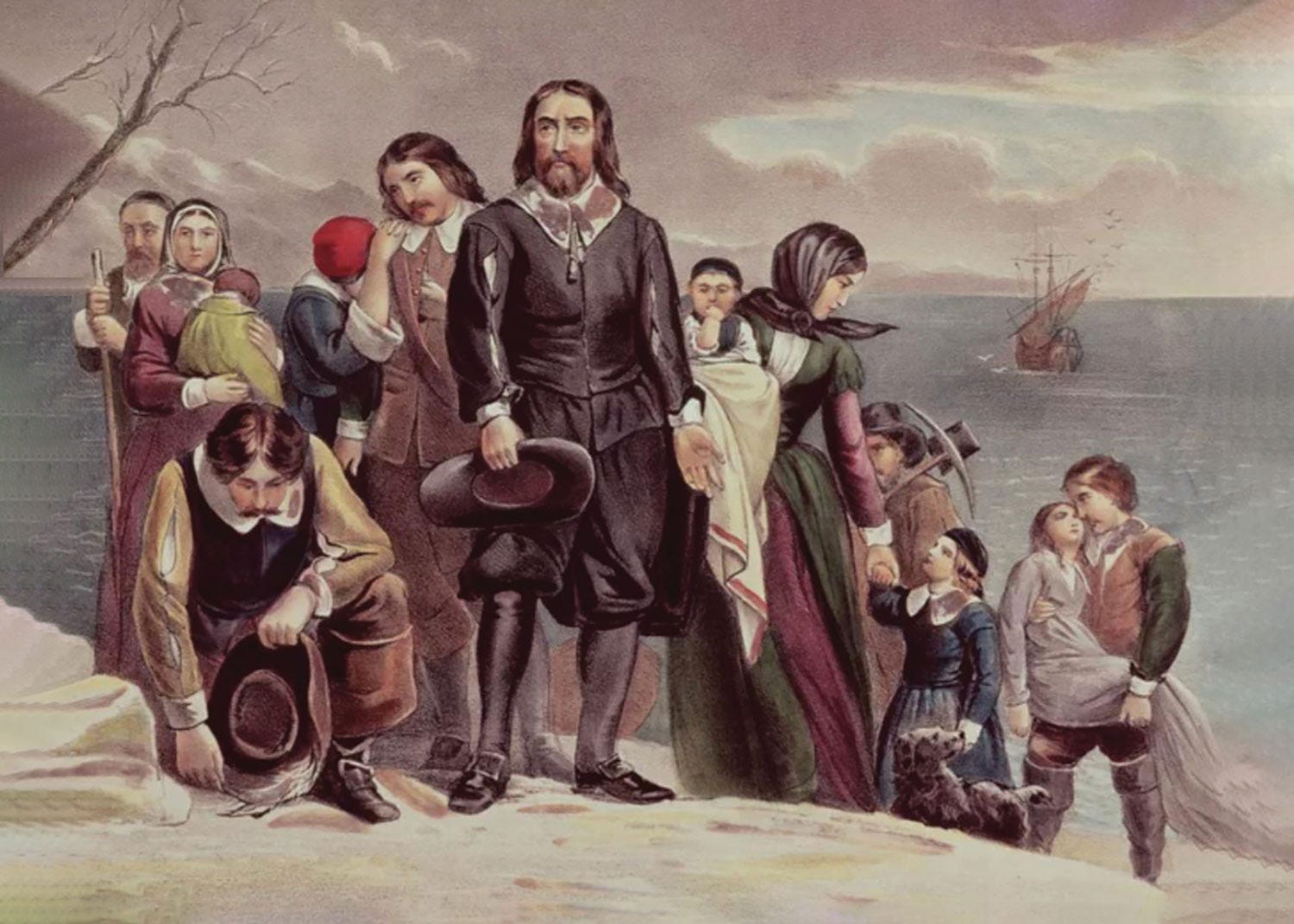
Between 1621 and 1656, William Bradford served as Governor of Plymouth Colony for a total of just over thirty years. The fact that he did not serve one consecutive term perhaps makes this feat even more impressive: “please lead us again” carries more mystique than the mere maintenance of the status quo; it’s also very American. He’d clearly earned the respect and loyalty of the men of Plymouth.
Much of what made Governor Bradford so worthy of respect—as far as personal and professional qualities are concerned—is left to the imagination. Because while he left behind Of Plymouth Plantation, this book is more of a journal of a people than a diary of one man’s journey. It is to our benefit that we’ve been provided this portrait of community survival as we can glean from it a nation-in-infancy, instead of one glimpse of one man’s role in building the community.
Perhaps this was consistent with the day’s writing-style, but in the book Governor Bradford rarely refers to himself in the first person, instead using third person or “The Governor.” When speaking of the people of Plymouth, he uses “they” and not “we,” as if telling a tale of a people discovering their way, documented by a distant source, when in-fact the one doing the documenting had also led the way. Bradford would of course shudder at this last point; God led the way.
Indeed, the years covered in On Plymouth Plantation causes one to think of the many years of Israelite wandering in the wilderness, though the Pilgrims seem to have dealt with their suffering better than the Israelites did; not to say that they were perfect, but there’s a reason Thanksgiving exists.
As far as personal sufferings go, Governor Bradford lost his parents at an early age, then lost his grandfather shortly after he was taken in by his grandparents, leading to him being sent to live with an aunt and uncle who likely took him in out of duty and not familial love. He was often sick as a child and young adult, which made him a reader. One of the books he got his hands on was the Bible, not yet a common text in most households. With the extra time on his hands and with all of Scripture open to him, it might be accurate to say that in his sickness he became a non-conformist.
This non-conformity is of course what led the Separatists to America. The Pilgrim arrival upon the shores of New England brought not just the collective suffering alluded to above but also even more personal suffering to William Bradford. Before even setting foot on land, Bradford’s wife died. Documents say she “fell overboard,” but some believed she jumped, taking her own life, not desiring to face the travails that lay ahead. Regardless of how it actually happened, it is events like these that make or break a man. It’s clear which path Bradford chose; though, again, he would not have put it this way.
In 1630 the London Council for New England filed the patent for Plymouth in Governor Bradford’s name. Like William Penn in Pennsylvania and Lord Baltimore in Maryland, William Bradford could have been sole proprietor of Plymouth, which would have resulted in him becoming a very rich man. Instead, he shared his rights with the original settlers, then in 1640 the patent was surrendered to all freemen of the colony.
When one thinks of Puritan New England the concept of a “City Upon a Hill” often comes to mind. This did not come from William Bradford nor from Plymouth Colony; it was a Governor John Winthrop invention in Massachusetts Bay Colony. Governor Bradford instead sought to construct a community separate from the world—in it but not of it. In this separation he helped forge a nation.
“Thus out of small beginnings greater things have been produced by His hand that made all things of nothing, and gives being to all things that are; and, as one candle may light a thousand, so the light here kindled hath shone unto many, yea in some sort to our whole nation; let the glorious name of Jehovah have all the praise.”
-William Bradford, Of Plymouth Plantation
Please consider purchasing a copy of my new magazine. The January 2026 issue can be found here. More about it here. Thank you!